
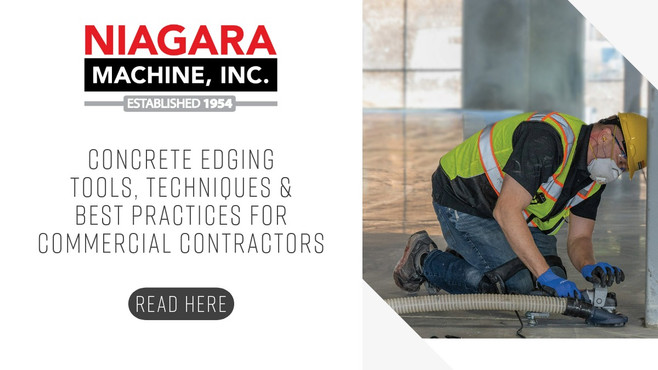
The Professional's Guide to Concrete Edging Tools, Techniques & Best Practices for Commercial Contractors
8th Dec 2025
When tackling large-scale commercial floor projects—from polished concrete showrooms to industrial coating preparations—the quality of the work is judged not just by the main floor area, but by the uniformity of the edges. For commercial contractors, mastering concrete edging is the difference between an acceptable finish and a truly professional, durable result.
This guide explores the essential tools, techniques, and best practices for commercial concrete edging, ensuring you achieve seamless transitions and maximum floor integrity on every job.
What Is Concrete Edging and Why Does It Matter on Commercial Jobs
In the world of commercial floor preparation and polishing, concrete edging refers to the process of grinding, leveling, and refining the perimeter of a concrete slab, the area where the floor meets a wall, column, or other vertical obstruction.
Unlike decorative landscape edging, this form of concrete edging is a critical, functional step. Proper edge work is vital because standard walk-behind planetary grinders cannot get flush against a vertical surface. This leaves a "halo" or strip of concrete that must be processed separately.
Why Quality Edge Work Is Critical
- Durability and Coating Performance: Failing to prep the edges to the same Concrete Surface Profile (CSP) as the field area compromises the adhesion of coatings (epoxies, polyaspartics) near walls. This often leads to premature failure, peeling, or chipping along the perimeter.
- Uniform Appearance: For polished concrete and grind-and-seal finishes, the edges must match the main floor’s aggregate exposure and sheen level. A visible difference—often called a "halo"—can ruin the aesthetic of an otherwise perfect floor.
- Project Examples: Concrete edging is non-negotiable in environments where aesthetics and integrity are paramount, such as high-end retail stores, warehouses with tight clearance around racking, and food production facilities requiring seamless, cleanable floors.
Types of Edging Tools for Concrete Contractors
Selecting the correct edging tool for concrete is crucial for efficiency and quality. Professional contractors rely on two primary categories of equipment, often using both on a single job:
Concrete Edge Grinders
A concrete edge grinder is a dedicated, specialized machine designed specifically for floor perimeter work. These are typically smaller, single-head rotary or planetary machines with a low-profile grinding head that allows the diamond tooling to get much closer to the wall than a large walk-behind grinder.
- Contractor Use: Contractors choose a dedicated concrete edge grinder for maximum productivity on large-scale commercial and industrial jobs. They are engineered for continuous, long-duration use and provide more consistent pressure and a flatter cut than most handheld tools, helping to remove aggressive coatings and level high spots quickly.
- Performance: Edge grinders significantly outperform hand tools by covering a wider path, maintaining a more consistent RPM, and reducing operator fatigue.
Handheld Grinders for Concrete Edging
Handheld grinders (such as angle grinders) are indispensable on commercial projects for their versatility, especially when a walk-behind concrete edge grinder cannot reach.
- When Handhelds are Preferred: Handheld grinders are the go-to edging tool for concrete in tight corners, small closet areas, stair landings, and for refining the final few millimeters next to a wall. They are essential for blending transitions between the main floor and the edge work.
- Niagara Machine Options: We have high-performance handheld options from industry-leading brands like Lavina Edgers, DiamaPro Edgers, and the Terrco Edger, all designed with professional-grade power and dust management.
Specialty Edging Attachments and Accessories
The right accessories turn good equipment into great performance.
- Diamond Tooling: Selecting specialized diamond tooling—metal bond segments, PCD scrapers, or resin pucks—is critical to match the aggression and grit progression of the main floor grinder.
- Dust Control: Every edging tool for concrete requires a robust dust shroud and HEPA vacuum system connection. This ensures operator safety and compliance with OSHA regulations for crystalline silica exposure.
How to Choose the Right Edging Tool for Your Concrete Project
The decision between a walk-behind edger and a handheld grinder depends on the specific job parameters.
Job Size and Commercial Application
- Small Commercial Rooms: Handheld grinders with a high-quality dust shroud are often sufficient.
- Large Industrial Facilities: Projects like warehouses and big-box retail require a dedicated concrete edge grinder paired with large planetary grinders for maximum production speed and uniformity in the concrete edging process.
Surface Material and Desired Finish Level
- Coating Prep: Requires a highly aggressive approach, often using a PCD cup wheel on a handheld or coarse metal-bond diamonds on a concrete edge grinder to achieve the necessary CSP.
- Polished Concrete: Requires a full grit progression on the edges (metal, hybrid, resin) to achieve a seamless, high-gloss finish that perfectly matches the center of the floor.
- Grind-and-Seal: Concrete edging is performed up to the desired scratch pattern, focusing on flatness and profile before the sealer is applied.
Safety and Dust Control Requirements
For any form of concrete edging, adherence to OSHA is mandatory for commercial contractors. This involves using a grinder with a compatible dust shroud connected to a certified HEPA industrial vacuum system with the appropriate airflow (CFM) for the grinding head size. This protects your workers and prevents costly project shutdowns.
Step-by-Step Guide: How to Edge Concrete Floors Efficiently
Achieving professional concrete edging is a four-step process.
Step 1 — Inspect and Prep the Edges
Clear the area of all debris. Use a scraper to remove high spots, excess drywall mud, paint, or thick adhesives along the perimeter. This prevents premature wear of your diamond tooling.
Step 2 — Select the Correct Diamond Tooling
Match your edge tooling to the main floor's tooling sequence. If you start the main floor with a 30-grit metal bond, start the edge with the same. This ensures the scratch pattern and aggregate exposure will be consistent when blending.
Step 3 — Use Proper Grinder Technique
Whether using a dedicated edger or a handheld edging tool for concrete, maintain a consistent path and pressure. Avoid dwelling in one spot, which can create dips or "gouging." Move the tool in a slight overlapping circular or pendulum motion to eliminate harsh lines and match the speed and pattern of the main grinder's cut.
Step 4 — Blend the Edges with the Main Field Area
This is the most critical step for quality concrete edging. The goal is to make the edge work indistinguishable from the main floor.
- Avoid Sheen Difference: Use a full refinement sequence on the edge. After the initial cut, slightly overlap the edge grinder’s path with the main planetary grinder on subsequent passes to feather the transition zone.
- When to Change Direction: On the final resin steps, change the direction of your edge passes and use a figure-eight or overlapping motion to erase any linear scratch marks and ensure a perfect blend.
Common Concrete Edging Mistakes (and How to Avoid Them)
Poorly executed concrete edging can compromise an entire project's appearance and lifespan.
- Uneven Blending: The "halo" effect. Avoid it: Always overlap the edge grinder path with the main grinder on your first few passes and maintain the full grit sequence on the edge.
- Skipping Steps: Moving from a very coarse metal grit to a fine resin grit on the edge. Avoid it: Follow the exact same metal/hybrid/resin progression as the main floor to ensure scratch marks are fully removed.
- Not Controlling Dust: Operating without a HEPA-compliant vacuum and shroud. Avoid it: This is a safety and regulatory failure. Always use a proper shroud system on your concrete edge grinder and handheld tools.
- Overworking Edges: Causing swirls, deep cuts, or burn marks. Avoid it: Maintain consistent speed and pressure. Use a lighter touch or a variable-speed handheld for the final polishing steps.
Recommended Equipment for Concrete Edging
A professional setup requires a cohesive system of machines and accessories built for high production.
- Concrete Edge Grinders: Choose machines built for low-profile access and durability.
- Handheld Grinders: Opt for variable-speed models with high-torque motors.
- Diamond Tools and Cup Wheels for Edge Work: Keep dedicated sets of diamond tooling (coarse metal, hybrid, and resin) specifically for edge machines and handheld tools.
- Industrial Vacuums: HEPA-certified vacuums are non-negotiable for silica dust capture.
Niagara Machine offers a full line of premium Concrete Edgers, accessories, and diamond tooling needed for flawless concrete edging on any commercial project.
When to Use a Concrete Edge Grinder vs a Handheld Grinder
|
Feature |
Dedicated Concrete Edge Grinder |
Handheld Grinder (Angle Grinder) |
|
Path Width |
Wide (7"–10" diameter heads) |
Narrow (5"–7" diameter cup wheels) |
|
Productivity |
High – Ideal for miles of perimeter concrete edging |
Low – Best for small areas, corners, and detail work |
|
Consistency |
Excellent – Weight and design ensure a flatter cut |
Fair – Operator pressure/angle can cause swirls or dips |
|
Typical Use |
Large industrial, retail, or warehouse floor prep |
Closets, columns, doorways, stair landings, wall transitions |
|
Pros |
Faster, better leveling, less operator fatigue |
Versatile, low upfront cost, reaches tightest spots |
|
Cons |
Still needs a handheld for the last few millimeters |
Causes faster operator fatigue, less aggressive cut |
For commercial contractors and polishing professionals, the walk-behind concrete edge grinder is the production choice, while the handheld is the detail tool. Both are essential.
Get Better Results with Professional Training
Mastery of concrete edging techniques requires hands-on experience and training. Understanding how your chosen tooling interacts with the specific slab hardness, how to properly blend the perimeter, and how to maintain OSHA compliance is best learned from experts.
Elevate your crew's performance and ensure flawless results on your next commercial floor.
Keep an eye open for postings of our hands-on Training Seminars to master professional concrete grinding and polishing techniques.