
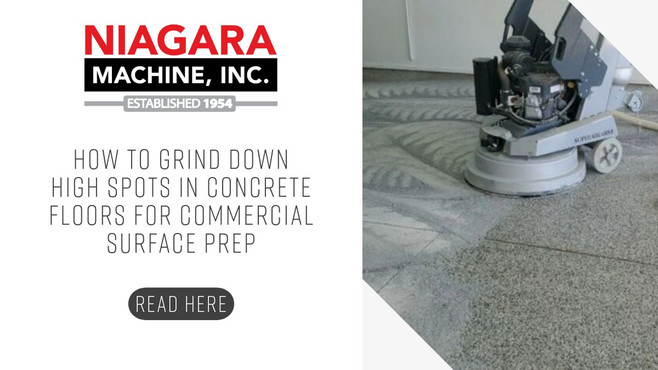
How to Grind Down High Spots in Concrete Floors for Commercial Surface Prep
25th Nov 2025
Before applying commercial floor coatings, installing new overlays, or achieving a pristine polished concrete finish, contractors must ensure the slab is level. High spots in a concrete floor can be a major obstacle, leading to coating failures, uneven final appearances, and poor equipment performance. The ability to efficiently grind concrete floor high spots is a fundamental skill in professional surface preparation.
This guide provides commercial contractors with the necessary steps and equipment recommendations to effectively tackle the job of grinding down these inconsistencies.
Why High Spots Occur in Concrete Floors
High spots, or localized elevated areas, are a common problem in both new and old concrete slabs. They primarily occur due to:
-
Uneven Pours: Variations in the concrete mix volume or improper screeding during the initial pour.
-
Settling: Differential settlement of the sub-base beneath the slab.
-
Troweling Inconsistencies: Hand or machine troweling mistakes that leave ridges or slightly humped areas.
-
Prior Coating Failures: Residual high-build coating material or patch compounds that were not fully removed during previous surface prep.
The presence of high spots severely impacts the quality of subsequent floor treatments. They can lead to:
-
Coating Failures: Thinning out of self-leveling epoxies or polyurethanes over high areas, leading to premature wear and failure.
-
Polished Concrete Results: Inconsistent reflectivity and noticeable low spots (bird baths) where the grinder couldn't reach, or "ghosting" where the aggregate exposure varies dramatically.
1 -
Equipment Performance: Grinding equipment bouncing or skipping, resulting in an uneven profile.
For these reasons, commercial contractors must always grind concrete high spots before starting any major surface preparation.
How to Identify High Spots in Concrete Floors
Accurate identification is the first step in successful removal.
Using Straightedges and Floor Profiling Tools
The most common method for checking floor levelness is the use of a straightedge.
-
Lay the Straightedge: Place the straightedge across the slab and shine a flashlight from behind. Any light visible beneath the straightedge indicates a low area, while contact points identify a high spot.
-
Check for Undulations: Move the straightedge across the floor in multiple directions (parallel, perpendicular, and diagonal) to check for undulations and inconsistent elevations.
For large projects or when tight tolerances are required, precision surface measurement equipment, such as a digital profilometer or a laser level, can be used to generate a detailed topographical map of the floor's elevation.
Marking High Areas for Grinding
Once identified, high spots should be clearly marked to visualize the area that needs attention before you start to grind the concrete floor high spots.
-
Use Crayon or Marker: Use a bright, contrasting crayon or spray chalk to outline the high points. You can also use a chalk line to create a grid pattern for systematic checking.
-
Layout Planning: A clear layout plan minimizes guesswork, reduces the risk of removing too much material, and ultimately helps prevent rework.
Best Tools for Grinding Down High Spots in Concrete Floors
Choosing the right equipment is crucial for efficiently grinding down high spots concrete floors.
Planetary Floor Grinders
For large, elevated slab areas or significant floor leveling tasks in commercial spaces, heavy-duty planetary floor grinders are the preferred tool.
-
When to Use: They provide the weight and power needed for aggressive material removal across expansive areas, making them ideal for warehouses, big-box stores, manufacturing facilities, and retail environments.
-
Benefits: Their multi-head design ensures a wide, flat grinding path and a consistent profile, which is essential for uniform results. Learn more about the options available at
Concrete Floor Grinders
Handheld Grinders for Tight or Localized High Spots
For smaller, localized high points, edges, corners, or transitions that a large machine cannot access, a handheld grinder is necessary.
-
Ideal Use: They offer maneuverability and precision for isolated spot correction.
3 -
Tooling: Be sure to use these handheld tools with compatible grinding cups and shrouds for effective dust control. Explore options for
Handheld Grinders
Diamond Tooling for High Spot Removal
The effectiveness of any grinder depends heavily on the diamond tooling utilized.
-
Metal-Bond Diamonds: For aggressive material removal needed to grind concrete high spots, you will typically need metal-bond diamonds with a soft or medium bond and a coarse grit. This combination allows the diamonds to expose and cut quickly through hard material.
-
Grit Selection: A coarse grit maximizes leveling speed. As the high spots are leveled, you can transition to finer grits for blending and achieving the final profile, reducing the risk of deep scratches or gouges. Check out compatible
Diamond Tooling
How to Grind Concrete High Spots: Step-by-Step Guide
Follow these steps for successful high spot removal.
Step 1 — Prepare the Area and Ensure Safety
Clear all debris and obstacles from the work area. Safety is paramount: always use proper Personal Protective Equipment (PPE), including respirators, safety glasses, gloves, and hearing protection. Connect all grinding equipment to OSHA-compliant dust control equipment (industrial vacuums) to manage the silica dust generated.
Step 2 — Select the Correct Grinder and Tooling
For large, high-elevation areas, opt for the planetary grinder with aggressive, coarse-grit diamond segments. For smaller, precise areas, choose a handheld grinder with a turbo cup wheel. The goal is rapid material removal to grind concrete floor high spots.
Step 3 — Begin Grinding the High Spots
Start the grinder directly over the marked high area. The technique is to keep the machine moving constantly, avoiding excessive dwell time in one spot, which can lead to creating a dip or a gouge.
-
Low and Slow: Apply steady, even pressure and maintain a consistent speed.
-
Controlled Passes: Work the high spot in controlled, intersecting passes. This cross-hatch pattern helps ensure you are lowering the area uniformly.
Step 4 — Recheck the Floor and Blend Surrounding Areas
Stop grinding and use your straightedge to recheck the area. When satisfied that the high spot has been leveled, you must feather the edges.
-
Feathering: Lightly grind the area immediately surrounding the corrected spot using slightly finer tooling (or the same aggressive tooling with less pressure) to create a gentle transition. This prevents a noticeable “shelf” or a ring-shaped low spot around the area where you had to grind concrete high spots.
Step 5 — Clean the Surface and Prep for the Next Step
Use an
Common Mistakes When Grinding Down High Spots (and How to Avoid Them)
Avoiding these pitfalls ensures a better finish and saves time:
-
Using the Wrong Grit or Bond Hardness: Using too fine a grit will take too long. A diamond bond that is too hard for the concrete will lead to glazing and inefficient cutting.
-
Removing Too Much Material Too Quickly: Aggressive material removal without frequent checking can easily lead to "overshooting" and creating a low spot, which is much harder to fix.
-
Not Maintaining Dust Control: Excessive dust obscures visibility, making it difficult to accurately see the high spots and the progress of the correction.
-
Overworking Edges: A common error when grinding down high spots on concrete floors is overworking the edges of the high spot, resulting in a noticeable dip or ring around the corrected area.
When to Use a Scarifier Instead of a Grinder
While grinding is effective for removing typical high spots and leveling inconsistencies, scarifying or planing is sometimes a more efficient choice.
-
Grinders: Ideal for minor high spots, leveling minor undulations, and achieving a final profile for coatings or polishing.
-
Scarifiers: Used for severe elevation problems (significant humps), removing thick coatings, or when you need to remove a substantial amount of material quickly and aggressively.
Applications Where Proper Leveling Is Critical
Effective floor leveling by grinding high spots is critical in:
-
Manufacturing Facilities: Ensures equipment, like forklifts and material handlers, operates smoothly and safely.
-
Commercial Interiors: Provides a level substrate for the application of tile, LVT, or carpet.
-
Coating Installations: Level floors are essential for the longevity and aesthetic success of epoxies, polyurethanes, and other seamless floor systems.
-
Polished Concrete Projects: Proper leveling ensures uniform aggregate exposure and a brilliant, consistent shine across the entire slab.
Recommended Equipment for Grinding High Spots
Niagara Machine carries the full range of equipment necessary to correct floor levelness. We offer various sizes of planetary grinders, versatile handheld grinders, and a complete line of high-quality metal-bond diamond tooling suitable for aggressive material removal and blending.
Ready to tackle your next commercial surface prep job?
Explore our concrete grinders, handheld tools, and diamond tooling to find the right solution for grinding down high spots on concrete floors.